
Plato and Lewis: Education is Formation or How do we do Chest Training?
 Adapted from a talk to our parents by Jim Reynolds Introduction When I asked my wife what would be important to say to parents of young children, she said, “Tell them that parenting is hard, demanding, exhausting, and confusing - that it is easy to doubt whether or not you are doing it right. Yet, it is also one of the best ways to know the love of God, because, when you realize how much you love your children and how much you would do anything for them, you have a small foretaste of the Father’s immense love for you.” I think this is a beautiful insight. I wish she were here to deliver the rest of this talk! My wife and I attend an Anglican church in Richmond, VA. Each week, as we dismiss the children from Sunday morning worship to go to their classes, we pray this prayer. It is adapted from the Book of Common Prayer: Almighty God, Heavenly Father, You have blessed us with the joy and care of children. Give us calm strength and patient wisdom as we bring them up that we may teach them to love whatever is just and true and good, following the example of our Savior Jesus Christ. Amen. We do need “calm strength and patient wisdom.” I hope that this talk can contribute to that. I have come to realize that many of my talks are really book reports. For this talk, I am in debt to two authors: C.S. Lewis and his book, The Abolition of Man, and Plato, and his book, The Republic. I have probably read The Abolition of Man ten to fifteen times. The first time I read it, I did not understand it. I really had no clue what Lewis was talking about. He originally delivered the three chapters in the book as three lectures to an academic audience. He assumed, rightly so, that they were familiar with the many books and authors he referenced in the lectures. I, on the other hand, have only become more familiar with these authors as a result of reading Lewis and wanting to understand him. Over time, this book has turned out to be my favourite non-fiction book. It is also one of the most important books to read to understand what classical Christian education is about and why it is a such a worthwhile endeavour. I have two quotations from The Abolition of Man. These two quotations capture the focus of this talk. They are: “Without the aid of trained emotions, the intellect is powerless against the animal Organism.” “We were told it all long ago by Plato...The head rules the belly through the chest.” These are strange quotations. They do not have to make sense now, but I will have failed if they do not make sense by the end of our time together. We can tell from these quotations that Lewis, the foremost Christian thinker of the 21st Century, is leaning into Plato when he reflects on, and critiques, education. So we will too! Here is a road map for the rest of this talk. We will focus on: (A) what these two quotations mean (B) what implications they have Or, said in another way, what is the chest and how do we do chest training? Plato’s Republic: The Head, the Chest, and the Belly In The Republic, Plato is asking the big question: How can you have a just society? In Books I-III of The Republic, Socrates and his friends discuss how to get justice in the city, and then, in Book IV, they wonder if they can find the same sort of justice in the individual. They surmise that if they can find out how to have justice in both the city and the individual, “we might well make justice light up as if we were rubbing fire sticks together!” To explore justice in the individual, Plato develops a three-part model that uses our body parts to help us understand what we are on the inside. It is a model and certainly not the only way to understand what humans are, but Lewis found it very helpful to shed light on what the purpose of education (and parenting) is. Take a look at the chart below:  In the first column, we have the Head, the Chest, and the Belly. Then, in the second column, we relate these three parts to the second quotation above: the head to the intellect, the chest to trained emotions, and the belly to the animal organism. The next column answers this question: “What is it like when each part is working well?” When the head is working well, we make good decisions. When the chest is working well, we overcome fears. And when the belly is working well, we control our appetites (our desires). Thus, the belly is about what we want and the chest is about what we want to avoid. When all of these parts of a human soul are working well together, Plato concluded that we can act justly. The ancients had names for these moral virtues–they are called Cardinal Virtues and there are four of them (“Cardinal” means “hinge” - these virtues are the hinges that all other virtues depend on). Justice is the first Cardinal Virtue and to get it, you need the other three: you need a head full of prudence (good judgment), you need a chest full of fortitude (courage), and you need a belly full of moderation (self-control). In Plato’s model, the chest might be the most difficult part to understand. One way that fortitude shows up is with a kind of anger with one’s self. This anger or resolve in our chest supports the head’s good judgment to keep us from giving in to our belly’s desires. Plato gives an example of this with a man who wanted to be licentious. The man experienced the pull of his appetites and the countering voice of his prudence/reason telling him not to give in. But he also experienced something else - a righteous anger or self-reproach that “allies itself with the reason/head” and “fights a civil war with the appetites.” This is Plato’s case for three, not two, parts to the human soul, and this is also what Lewis meant when he said that “the head rules the belly through the chest.” Lewis explains this further in The Abolition of Man: "Without the aid of trained emotions, the intellect is powerless against the animal organism. I had sooner play cards against a man who was quite skeptical about ethics, but bred to believe that ‘a gentleman does not cheat’, than against an irreproachable moral philosopher who had been brought up among sharpers.” This is because the skeptical man has a chest, he has trained emotions–his formation has given him the settled disposition not to cheat. The desires in the belly, by the way, are not just physical desires - drink, food, and sex–they are also non-physical desires including the desire for money, power, and reputation. And the virtue for the belly is not the elimination of desire, but moderation or self-control, or as St. Augustine says, “ordo amoris” which means “ordered loves.” If the things I love include my car, my wife, God, my clothes, my wallet, and my children, I can well imagine that you could help me order these loves appropriately. I can also imagine that you can see what a disaster the improper ordering of these loves could result in. To see how important the chest is, it is worthwhile to reflect on what a person would be like if they were all head and belly. They might be clever or intelligent, but as Lewis’ earlier quotation explained, the head (intellect) is powerless against the belly (the animal organism) when there is no chest, no trained emotions. This person might know that they ought to be self-controlled, but they do not have the strength of the middle element, and so they live a life subject to their appetites without resolve or courage. Lewis particularly takes to task educators who debunk chest-training: who teach that there are no right emotional responses to reality, and who do not teach children to love what is lovely and to hate what is contemptible. About these teachers he says that they: “while teaching [a child] nothing about letters, have cut out of his soul, long before he is old enough to choose, the possibility of having certain experiences which thinkers of more authority than they have held to be generous, fruitful, and humane.” This “cutting out of the soul” is what Lewis meant by the “abolition of man.” It is hard to be human without a chest. A Model for Chest Training So if the chest is so important, how do we, as parents and educators, train it? Plato had a plan for this–and it mirrors many of the contemporary models that Christian thinkers have laid out for moral formation. Below, adapted from Plato’s The Republic, is a three-part model for chest training. Again, it is a model and not the only way to understand how humans grow in character, but this model has deep roots. 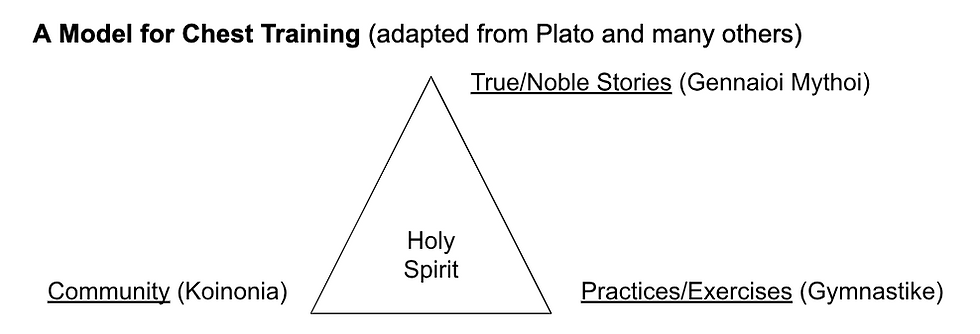 In the middle of the triangle is the Holy Spirit. Thus the model is not a self-help program; rather, it is fundamentally relational. Plato lived before Christ had died and risen from the dead. He lived before the Holy Spirit had been given to us. He did not know, in the words of St. Paul, “that it is God who works in [us], both to will and to work for his good pleasure” (Phil. 2: 13). The good news is that we are not doing this without God’s help! At the top of the triangle are the Greek words, Gennaioi Mythoi. This is Greek for true or noble stories. Plato believed we should control the stories that children listen to, sing, chant, heard sung, or see acted. He only wanted true and noble stories influencing children in their most formative years. I think he is right–and I would extend this to our entire lives. James Bryant Smith in his book, The Good and Beautiful God, says it this way: "Narrative is the central function of the human mind. We turn everything into a story to make sense of life. We dream in narrative, day-dream in narrative, remember, anticipate, hope, despair, doubt, plan, revise, criticize, construct, gossip, learn, hate and love by narrative. In fact, we cannot avoid it. We are storied creatures." In other words, stories are very powerful - they are the language of the soul. I realized this in my own life while reading Dallas Willard’s The Divine Conspiracy. In the book, he said, "Your life is perfectly safe in God’s hands.” I remember thinking, “no it is not”and then realizing that I had a different story in my head and heart than the Gospel. I knew then that I do not need formation - I need re-formation. I had breathed in a cultural story that was in my soul (i.e., that my hard work is all there is and that God at best is watching from a distance), and I needed a new and better story about God’s presence and good will. This has been a slow process of re-narration, but there is progress! We are storied creatures–our family stories, our cultural stories, and our scriptural stories form us - so we need to pay attention to them and nourish our children on beautiful stories! One family practice to do this is to read aloud often to your children, even when they are older! For many years now, Jim Trelease has published his Read Aloud Handbook. Parents love his curated list of books with age ranges and summaries that help them choose books that fit their children well. At the lower right corner of the triangle is the Greek word, Gymnastike. For Plato, this word referred to bodily training, but St. Paul grabbed ahold of this term and expanded it: "Have nothing to do with irreverent, silly myths. Rather train (gymnaze) yourself for godliness; for while bodily training (gymnasia) is of some value, godliness is of value in every way, as it holds promise for the present life and also for the life to come." (I Timothy 4: 7-8) “Train yourself for godliness.” What does that mean? Can we do practices that become habits that help us and our children grow in Christlikeness? The answer is yes! This is a consistent theme in Scripture. An old church name for these practices is “Means of Grace.” These are spiritual practices that allow us to receive grace–to draw near to God, to know God better! A practice that became a keystone habit in my life is doing Community Bible Reading. (A keystone habit is a single habit that helps make many other habits work well). Community Bible Reading has participants read one Old Testament chapter and one New Testament chapter every day and read from the Psalms on the weekend. Following this pattern, someone will read the New Testament each year and the Old Testament in three years. I had tried to read the whole Bible in a year, but that requires reading four chapters per day, and, if I missed two days, I was eight chapters behind with four new ones coming. I could not keep up. By doing daily Bible reading, Scripture passages and stories have started to show up in my head. Over time,I have gradually added and adapted other practices in the morning as well. My wife, Nancy, in her further advice to parents of young children, said to just do something each morning to set your compass toward God. It can be short–there might not be much time–and it can change, but the goal is to be with God, to be re-oriented away from regret and anxiety toward gratitude and kindness. Her experience is that this simple practice helped her stay more in God’s presence throughout the whole day. A family practice related to this comes from Mary Pipher’s book The Shelter of Each Other: Rebuilding Our Families. Mary Pipher is a counselor who said that when a family comes to her broken and discouraged, she encourages them to do three things together: meals, vacations, and time outdoors. Eat a meal together everyday, go on a vacation together, and get outdoors together–and do all of these without screens. Of course, these are good practices for healthy families as well. We can gymnaze ourselves for godliness! At the lower left corner is the Greek term, Koinonia. Plato advocated putting a select group of children into Koinonia (training communities) apart from their families to form them to be the guardians of the city. This was one of his least palatable ideas. But he is onto something–communities shape us. This word, Koinonia, is a common New Testament word. It shows up for the first time in the NT in The Book of Acts (here translated as “fellowship”): "And they devoted themselves to the apostles’ teaching and the fellowship, to the breaking of bread and the prayers. And awe came upon every soul, and many wonders and signs were being done through the apostles. And all who believed were together and had all things in common. And they were selling their possessions and belongings and distributing the proceeds to all, as any had need." (Acts 2: 42-45) So, Koinonia is active fellowship with others and with God. It is a community that cares for each other-eating together and sharing goods-and that is in relationship with God-awe came upon every soul! The truth is we are not only storied creatures, we are also communal creatures. It might even be true that we become just like our five closest friends. My wife and I have hosted a church small group for four years: we have had widows and divorcees, couples in marriages that struggle and yet have stayed together, single folks who wish they were married, and all sorts of children both adopted and not. In other words, we have had normal people in our small group–who all have scars and yet over time begin to tell each other about their lives. Once a week, we eat together, we study scripture, and we pray for each other. Outside of that time we help each other as we can when life gets overwhelming. It takes time–honestly, my wife and I do not always feel like we want to give the time–and yet it is probably the most important church thing we do. A family practice related to this is to practice hospitality. Maybe you could have a family over once per month from your church or the school. My wife and I have discovered that we need to plan this in advance or we will opt out of doing it. We have also discovered that we are very happy afterwards that we did it. We are communal. We need koinonia to grow in Christ–we are not meant to grow chests alone! The prayer I began with asked God to give us “calm strength and patient wisdom” as we raise and train our children. Maybe this is the prayer to begin each day with. It would remind us that we are not in this alone–we can ask God for calm strength–and that it is a slow process - we need patient wisdom. We can confidently ask for this because our prayers are based in what is real–the goodness and lovingkindness of God who has generously given us his Holy Spirit. ******* Books to read: C.S. Lewis, The Abolition of Man Justin Early, The Common Rule: Habits of Purpose for an Age of Distraction Justin Early, Habits of the Household: Practicing the Story of God in Everyday Family Rhythms James K.A. Smith, You Are What You Love: The Spiritual Power of Habit Jim is currently serving as an Accreditation Team Leader for the Society for Classical Learning. In 2021, he retired from the Veritas School, Richmond, VA, where he served as the Head of the Lower School. Before that, Jim was the Dean of Faculty for the Geneva School, Orlando, Florida. Earlier, Jim worked in elementary school publishing for Houghton Mifflin/Harcourt. He was an Educational Consultant, a Product Manager, and the Vice President/Editor-in-Chief for elementary mathematics. Currently, Jim volunteers at the Veritas School in Richmond, VA, both as a coach for the Moot Court Team and as a consultant for the Fellows Program. Jim’s wife, Nancy, works at - and Jim volunteers for - the Imago Dei Neighborhood School in Richmond, whose mission is to provide a Christian liberal arts education for families of all income levels. |


Comments